Disabled golfers fight for accessibility and acceptance
 By
By 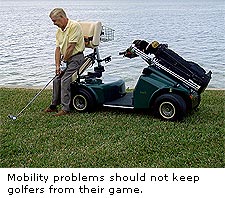
Bob Wilson is a member of the Manchester Golf Club in Bedford, N.H. He is a 12-handicap who has been golfing for 47 years, the last three decades of which, without the use of his legs from the knees down.
Wilson is a bilateral amputee as the result of an accident while serving in the U.S. Navy. He is also the executive director of the National Amputee Golf Association (NAGA), editor of Amputee Golfer magazine, and founder, lead instructor, and coordinator of the First Swing Program, which teaches golf to the physically challenged.
For golfers who think the sport is plenty hard enough, even with four working limbs, Wilson’s story sounds remarkable. As it turns out, however, there is a sizable subsection of golfers today who have overcome mobility issues in order to play the game they love.
Inspirational stories
No reliable statistics exist as to the number of people with disabilities who play golf, but according to Wilson, a PGA survey indicated that 24 percent of golfers are not playing due to “injury.” And according to John Hikel, owner of Total Access Golf, a distributor for SoloRider single-rider golf cars especially (but not solely) designed for players with mobility limitations, 22 percent of paralyzed veterans express an interest in playing the game.
Hikel can provide innumerable stories of inspiration and awe from his years of working and playing with disabled golfers. “I watched a golf tournament for amputees several years ago,” he recalls, “and was absolutely amazed at the ability of people with some severe amputations to play the game. I saw a man with one arm and only three fingers, and prosthetics for both legs, hit a 200-yard drive down the middle of the fairway, and hit his second shot on the green. Many golfers with no disability cannot do that!”
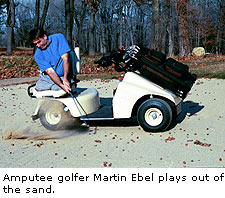 Martin Ebel, a Massachusetts attorney, was injured in 1983 and lost both of his legs above the knee. Like Bob Wilson, Ebel values golf as more than just a pastime. “For me, golf is the one thing that I still enjoy as I did before my accident, and playing makes me feel like I am not disabled,” he says. “I know this is true of many amputees – we simply do not feel disabled on the course when we are making golf shots and enjoying the camaraderie of the game.”
Unfortunately, disabled (and senior golfers who have lost mobility) find course access to be a major barrier to their participation in the sport. “On the course we face lots of resistance from the golf industry,” says Ebel. “Generally, golf facilities are not particularly accessible to people with disabilities and unfortunately there are people that take advantage of the accommodations that some golf courses do offer, even though they do not need the accommodations.”
Complying with the law
The Americans With Disabilites Act (ADA) covers public and semi-private golf courses, ensuring that such facilities be accessible to the disabled. Nevertheless, adherence to the law has come only grudgingly.
 As reported on the SoloRider website, a landmark 2002 settlement in Indianapolis unambiguously established the rights of disabled golfers. In the settlement the city of Indianapolis agreed with the U.S. Department of Justice “to make necessary changes at all twelve of their municipal golf courses to comply with the requirements of Title II of the American Disability Act (ADA).”
John Hikel, who as a distributor of SoloRider golf cars has an obvious stake in the issue, points out “Most golf courses are either not accessible or do not have a single rider golf car that meets the needs of many disabled people.” He stresses that the ADA “specifically defines golf courses as places of public accommodation.”
Hikel advises golfers with disabilities to be persistent, and to know their rights. “Some people may encounter a golf course that is not accessible and does not welcome a person with a disability,” he explains. “We suggest that the disabled person try to talk with the owner…and encourage them to make accommodation. If refused after sincere and reasonable effort, contact the USGA, National Golf Course Owners Association, SoloRider, and/or local government organizations concerned with discrimination. Hopefully, without civil action, the golf industry will become fully accessible sooner rather than later.”
In addition to the courts, the ruling bodies of golf have also recently moved to embrace disabled golfers. In 1984, Bob Wilson worked to change the decision of golf (14-3/15) regarding artificial devices. According to Wilson, “My lengthy dissertations with (then USGA Executive Director) P. J. Boatwright focused on retention of amputees in the game. Maybe that was the underlying reason for the recent publication of the ‘Modification of the Rules of Golf’ by the USGA and the R&A, which encompasses all forms of disabilities.”
Advances, accessibility, and acceptance
Making a course accessible means more than installing wheelchair ramps into the clubhouse. It also means allowing single-rider carts, such as the SoloRider, onto courses. According to Hikel and SoloRider users such as Martin Ebel and Bob Wilson, course owners and greenkeepers have to overcome a number of prejudices and fears before they embrace these carts.
First and foremost among these concerns are cost and damage to the course. With respect to cost, Hikel points out that “Compliance with the law is far less expensive than a lawsuit, and besides, it's the right thing to do."
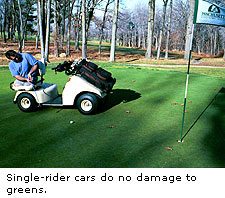
With respect to potential damage to the course, new, well-designed auxiliary aids such as the SoloRider feature wide tires and weight distribution schemes that leave imprints on the greens no more sever than those left by golf shoes. As such, the carts are safer for both the course and the golfers than traditional options.
Martin Ebel relates how the new cart technology has helped him enjoy the game: “When I first started playing golf after my accident, I used a wheelchair. The narrow tires were hard on the greens, so I did not putt to avoid damaging them. There were also difficulties in getting from shot to shot in a wheelchair. Eventually, I, like many disabled golfers, began using a three-wheeled scooter to play golf.
"While better than a wheelchair for hitting the ball and not damaging the course, the scooter was not particularly stable. I would regularly fall out of the scooter or tip it over.” Ebel was eager to try the adaptive single-rider cars like the SoloRider when they hit the market. He credits the SoloRider for providing him access to courses, as well as adding ten yards to his shots.
Finally, disabled golfers also have to overcome the preconceptions of able-bodied golfers. Ebel stresses that “Most of us (at least members of the NAGA) also cannot stand slow play. We much prefer four hour rounds to six hour rounds and are painfully aware that we are seen (usually inaccurately) as the cause of slow play.”
Pat McDonald, a parapalegic from the mid-chest down who carries a 1.7 handicap index and teaches golf to other disabled golfers, describes the reactions of able-bodied golfers who watch him swing for the first time as usually “all good.” Nevertheless he says, “They’re shocked when I’m on the green in two and they’re still pitching up.” McDonald adds, “There have been a handful of times when I joined up with a threesome, and by the 13th or 14th hole, one disappears. I ask where he’s gone, and they say he’s quit. Why? Because a guy in a wheelchair is kicking his butt.”
Bob Wilson offers the best way to think about golfers with disabilities: ”We are all golfers who play against the golf course, not each other. If playing the game simply means ‘hitting the ball,’ then there is no difference between us.”
For more information on resources for golfers with physical disabilities, go to solorider.com , amputee-golf.org, or totinbonezgolf.com.
August 26, 2004
Kiel Christianson has lived, worked, traveled and golfed extensively on three continents. As senior writer and equipment editor for WorldGolf.com, he has reviewed courses, resorts, and golf academies from California to Ireland, including his home course, Lake of the Woods G.C. in Mahomet, Ill. Read his golf blog here and follow him on Twitter @GolfWriterKiel.
LPGA fixture Donna Andrews continues her golf adventures at Pine Needles in North Carolina
Her transition has been fast and fearless, much like how Donna Andrews approached her LPGA golf career. Andrews has been the head instructor at Pine Needles Lodge & Golf Club since 2006. "I love teaching golf so much," she says. "I see the fun side of golf again."
... full article »- Don't be intimidated by the basics of golf
- Going Deep! The Ultimate In Golf Confidence - Part 2

lisa wrote on: Jan 20, 2018
Hi, my daughter wants to caddy for her daddy but struggling to find a cart that we can adapt to be pulled behind her power chair and he has easy access to the clubs because our daughter has limited range in her upper extremities. Any suggestions?
Reply
ronald christ wrote on: Jul 16, 2017
Hello, my name is Ron Christ and live in Salisbury, Mass. I am designing a subdivision 7 homes, and a golf course for under 12, over 65 and amputees. i hope to make money of course, but want to give something back, b-ball courts, tennis courts, etc. there will be a 1.5 mile walking path, wheelchair Acc. I have done alot of planning for this neighborhood. Anything for me to look at, the solo rider sounds essential, i have about 40 acres to work with, and am busy. do you have anything special in regard to access to the second shot, what kind of greens do wheelchair uses prefer, extra tough i imagine. If you have any plans for GC. and club house that might be helpfull. thank you, i am sincerely yours, Ron
Christ
Reply
Henry Palacio wrote on: May 21, 2014
I am a golfer who has polio and all my life I loved the game go golf I love it one that I know that I can play it it so hard to find a course that has the carts I still can' t find one here in San Antonio nor can I find people to play with how sad
Reply
Jason Faircloth wrote on: Nov 17, 2014
We are the United States Disabled Golf Association, WE are form to give disabled golfers a opportunity to compete in a National event. Our website is www.usdga.net facebook at usdga.net and twitter @usdga, WE are having our first US Disabled Open July 2015 in North Carolina. Three category based off your golf handicap, overall gross as well. All Disabilities is welcome and is on the site, as relates to golf swing other then ageing
Reply
jim prior wrote on: Apr 10, 2013
within the last four years I have a disability that does not allow me to walk distances, I can walk 10 to 30 metres at a time but it is slow. I would like to find cources that cater to golfers with my condition I live in Brampton Ont, and there are dozens of courses within a half hour drive.any suggestions
Reply
Hank wrote on: Jun 28, 2013
RE: disabled golfers
Hank wrote on: Apr 19, 2013
I have a lung condition which limits my ability to walk for long periods and I certainly am limited in how far and often I can walk during a game of golf. I take pulmunary Therapy twice a week for my condition and I also take medication and am under regular care of a Physician. I have a State Issued Disability ID Card, Drivers License, and Vehicle Registration (plate and hanging mirrior tag). I went on line an bought a "Handiapped" flag which goes on a golf cart. (Didn't even know they made such a thing). When I go to a golf course I show my ID Card and tell them I have my own flag . . . no course has ever given me a problem. I've always been told "go where you want, but please don't drive on the greens and tees and also don't drive in the sand traps. I'm 69 years old and I also play from the "RED" tees. I have a great time and I'm always thankful for the understanding nature of the course managers. Perhaps you can do the same! If you just met me on the street you'd never know I was disabled . . . but the fact is I am!
Well that was my oriiginal post . . . since then I actually have run into a problem with a golf course regarding me displaying my disbled flag on the golf cart . . . . I have been there twice and both times a "Ambassador" (course marshall) has told me to remove the flag as they wouldn't want other players to go out and buy disabled flags and have it get out of hand . . . I complied in a courteous manner and have been unable to converse with anyone in a position of authority and they did not answer email I sent them twice now. Any advice on what to do now????? Hank
Reply
Hank wrote on: Apr 20, 2013
I have a lung condition which limits my ability to walk for long periods and I certainly am limited in how far and often I can walk during a game of golf. I take pulmunary Therapy twice a week for my condition and I also take medication and am under regular care of a Physician. I have a State Issued Disability ID Card, Drivers License, and Vehicle Registration (plate and hanging mirrior tag). I went on line an bought a "Handiapped" flag which goes on a golf cart. (Didn't even know they made such a thing). When I go to a golf course I show my ID Card and tell them I have my own flag . . . no course has ever given me a problem. I've always been told "go where you want, but please don't drive on the greens and tees and also don't drive in the sand traps. I'm 69 years old and I also play from the "RED" tees. I have a great time and I'm always thankful for the understanding nature of the course managers. Perhaps you can do the same! If you just met me on the street you'd never know I was disabled . . . but the fact is I am!
Reply
Mac GIllum wrote on: Jan 16, 2013
HI. I Have invented a Golf Glove for people with hand problems,know of glofers who need help let me know, thanks Mac
Reply
Keith Van Sickle wrote on: Aug 25, 2018
I have lost my 2nd and 3rd fingers on my left hand and have not been able to hit the golf ball with any skill. I am right hand golfer. Would your golf glove help.
Reply
Bill Crews wrote on: Jun 11, 2014
Tell me about your glove. My left hand is stroke affected.
Reply
Eduardo Hernaez wrote on: May 10, 2015
My left wrist has severe arthritis and painful to swing a golf club. My fingers are getting hard to close, on both hands. I use graphite shafts and thick club grips.
Can your golf Glove help me?
- - - Thank you - - -
Reply
Robert W. Smith wrote on: May 4, 2012
I have a neuropathy which affects both feet. Muscles in feet, lower legs and ankles have atrophied.I wear braces and have trouble with my balance when swinging my golf clubs. Needless to say my swing has suffered. I need some help from a pro who is experienced with disabled golfers who can watch my swing and make suggestions about how I can best change my set up and swing to accomodate the disability. Any golf schools you can recommend?
Reply
Jason Faircloth wrote on: Nov 17, 2014
We are the United States Disabled Golf Association, WE are form to give disabled golfers a opportunity to compete in National event. Our website is www.usdga.net facebook at usdga.net and twitter @usdga, WE are having our first US Disabled Open July 2015 in North Carolina. Three category based off your golf handicap, overall as well.
Reply
Mike Etie wrote on: Apr 17, 2012
I have a friend who is a dwarf. He has a great swing and could be a good player, but he can't hit it far enough because of the club construction. All of his clubs are chopped short at the handle and loses it's kick and flexibility. Are there clubs made for little people? Should he consider junior clubs?
Reply
Jason Faircloth wrote on: Nov 17, 2014
We are the United States Disabled Golf Association, WE are form to give disabled golfers a opportunity to compete in National event. Our website is www.usdga.net facebook at usdga.net and twitter @usdga, WE are having our first US Disabled Open July 2015 in North Carolina. Three category based off your golf handicap, overall as well.
Reply
bill clark wrote on: Oct 14, 2011
I have both rotator culfs torn in both shoulders and they cannot be reattached so I am trying to find a pro to help me develop a swing where my shoulders don't come into play.
Reply
Bill Wright wrote on: Feb 1, 2015
I have invented a golf club for use by those who cannot swing a golf club. It can be used on any golf course with damaging it. It is in early stage of development and I am seeking backers thru Kickstarter http://kck.st/1DNEyRq. This club is designed for ordinary people who might like to play golf and is not yet sanctioned for USGA events. I believe it will open up the game of golf to approx. 500,000 disabled people in this country alone. I need help moving it to production. I wish you all well as you enjoy the game of golf.
Reply
Mac wrote on: Jun 5, 2011
I was injured falling of a ladder 14 feet high. I crushed 7 bones in the elbow, and broke 2 bones between the wrist and elbow. I was a 14 handicaper before the accident. I need help using my lower hips and legs to help with my distance. I love the game of Golf. Any suggestions? Where can I go to have a pro look at my swing.
Thanks
Mac
Reply
GERALD ABRAHAM wrote on: Apr 27, 2011
COST OF THIS EQUIPMENT AND DO KNOWIF ANY OF THIS IS MAY BE COVERED BY INSURANCE. MY WALKING IS IMPAIRED BY 4 BRAIN TUMOR OPERATIONS
864 5970452
Reply
GERALD ABRAHAM wrote on: Feb 23, 2012
DO YOY KNOW IF THIS EQUIPMENT IS COVERED BY INSURANCE CO.S OR MEDICARE. THANK YOU.
Reply
marc wrote on: Mar 1, 2011
back surgery left me with 3 replaced disc L 3,4,5 and a fusion s1,, i am looking for a pga pro that can help me with lessons in so.cal the inland impire. can you help 9519664459 thanks
Reply
erwin Dargis wrote on: Jun 11, 2010
I fell on the ladder and busted up my right elbow to the point that it can't be bent. It's in a permanent 90%. Is there some thing i can do to put a decent swing on a bolf ball. Right now i can't seem to get it air bourn and i'm duck hooking every shot.
I'm looking for some pro that can help me with my disability. Do you know of some one. I live in the Minneapolis mn. area.
Reply
Greg wrote on: Mar 31, 2011
Erwin,
Do to nerve damage I play with 1 arm. I also went to golf college in Temecula, Ca. for 2 yrs. and earned a degree. As an instructor I can say that each person and their swing is different, disabled or not. Playing with 1 arm I have shot an 84 which was better than any score I ever had when I played with 2 arms. Maybe you can open your stance, and have your right hand on the club only half the swing, then let go and follow through with the left arm. Most of your power is in the left side (if your a right handed player). What I'm trying to say is that you CAN DO IT. It will take practice and maybe some trial and error. But, once you hit the ball well JUST ONE TIME you will KNOW which is the best way for you. It took me 2 years to find my best 1 arm swing and stance combination but when you find it you know it was worth the time and effort. Good LUCK & NEVER GIVE UP!
Reply
Jason Faircloth wrote on: Nov 17, 2014
We are the United States Disabled Golf Association, WE are form to give disabled golfers a opportunity to compete in National event. Our website is www.usdga.net facebook at usdga.net and twitter @usdga, WE are having our first US Disabled Open July 2015 in North Carolina. Three category based off your golf handicap, overall as well. This is the first championship well all disabilities are welcome as it relate to making a swing. Details is on the website.
Reply
Paul meyer wrote on: Oct 23, 2010
You may have already found someone but...
I would be interested in seeing what can be done to help you play golf and enjoy the game. I'm a teaching professional in Western, WI. I've recently worked with a man who has had 4 back fusions and a pin in his left wrist. I realize we are at the end of the season but I would like to talk to you.
I'm in the process of trying to find grips for my father who isn't able to grip with his left hand. Helping the disabled golfer has become a goal of mine.
Reply
Marc Bright wrote on: Sep 14, 2010
hello erwin,I'm a pro from australia,queensland,sunshine coast.the duck hook is curable by recommitting yourself to 'good body control over your swing'..also making an emphasis on strenghening the rest of your body with sit-up/swivels and working your body weight+ golf posture to bring the club Head 'into,thru,and along' the intended line of flight;
As you Build up your control over the club head with you Left hand golf grip you can train yourself to move your right arm+hands to 'accompany'this new way with increasing club head speed. you may be served by making your shfts alittle lighter+more flexible with more kick at the business end of the shot. regards Marc Bright..
Reply
John Ritchie wrote on: Apr 3, 2010
I have developed a tool to set the ball on the tee. Worth a look. Gives complete control from standing position, no bending, allows user to set ball on a tee. Also picks tee from ground after tee shot. Let me know if you and your friends are interested.
Reply
Lynette Hoehn wrote on: Nov 29, 2011
My husband's hip replacements make it difficult to bend over and tee the ball. I tee his balls when we play. Is there a tool that can place a ball and a tee in the ground from a standing position?
Reply
Dallas Lewis wrote on: Mar 6, 2011
I live in Chico, California. I have a bad back, bad hips, bad right knee & bad right ankle. All from injuries. I am interested in your tool. Please send me pictures & prices including shipping costs. I might be able to get the local golf courses & clubs to handle them.
Reply
Jim Shepherd wrote on: Oct 31, 2010
Hi: I am very interested in your tool. I have both hips replaced and a fusion in my lower back. This week my hip dislocated when I was puttig my tee in the ground. Even with all the metal parts I have a 12 handicap. I have a device my friend gave me for getting the ball out of the cup. I would be glad to share that. NEED HELP GETTING THE BALL ON THE TEE. HOPE YOU CAN HELP. THANKS JIM
Reply
Dale R. Reynolds wrote on: Oct 8, 2010
I would love to see a photo of your tool. I have a fused back and drop-foot and bending to place a tee and ball is very difficult.
Reply
Bob Koch wrote on: Aug 10, 2010
I would be interested in seeing this also. Having also had spinal fusion and knees that also don't work right this might help me play a game I love.
Reply
John Williams wrote on: Jul 9, 2010
I am interested. Hurt in the service and after many operations cannot bend to place tee.
Reply
Joe Baker wrote on: May 9, 2010
Would like to see a picture of your tool & what the price would be. Have had spinal surgery and have a hard time putting ball on tee.
Reply
Mac Gillum wrote on: Jan 26, 2012
I Have lost the use of my left hand also and found a golf glove called sure grip sports glove helped me alot
Reply
EDWARD LYNCH wrote on: Sep 21, 2009
I was looking for instruction on how I must compensate for grip and power loss in my left hand. I had a carpal tunnel operation (twice) that permanently damaged my nerves in my hand. The result of making my left hand inaffective to any strength or finger (digital) gripping power for my thumb, and the first and second fingers.
I need to develop a new grip and was looking for any help regarding this issue. I am not looking to achieve my power drives of before,but, accurate 200 yds. in the fairway would be delightful.
EML
Reply
Susan Massey wrote on: Sep 4, 2010
I also have lost grip and power in my left hand due to brachial plexus injury and a misdiagnosed trapped ulnar nerve.I have lost both my hobbies playingthe clarinet and golf, any news on equiptment for a disability such as mine would be much appreciated.
Reply
bob davignon wrote on: May 3, 2010
lost my ring, and little finger. my ring finger is doable my question is there any company that makes grips that would help me have a better grip on the club. ive seen the grip aide. would that one be legal your responce on this would be appreciated thank you bob
Reply
Dale Reynolds wrote on: Jun 10, 2009
I have a condition called foot drop on my left foot. Foot drop is a condition where the nerves connecting the spine to the foot are damaged and the individual cannot lift his or her foot into a normal walking position. Most people with foot drop wear a brace to keep the foot in a neutral position. I can walk with the help of a cane and I can walk without a cane a short distance as on a small green and tees that are not elevated. However a am very unsteady on my feet and sometimes fall on the tee or fairway. Also I cannot bend over far enough to retrieve my ball from the cup or my tee from the tee box. I know that this is nothing to what amputee golfers must face, but you or your organization consider this a handicap? a couple my local golf courses have, like PGA National in Palm Beach Gardens, FL, and the Champions Club in Stuart, FL. Both provide handicapped flags for my cart.
Reply
roy cook wrote on: May 8, 2010
i've recently had a problem with foot drop myself. i've just got a large brace for my rt foot but this is harder on me playing golf than w/o the brace. i just found out about a slightly smaller brace called PLS.i;m hoping to get one in the near future; hope this will help with your foot drop problem thanks roy
Reply
Andrew Letier wrote on: Jun 9, 2010
I have Foot Drop
and wear Toe off made in sweden a great brace
very light and great for golf.
If you can"t find it send me a E Mail and I will get you the info (aletier@aol.com)
Reply
kabir osundiya wrote on: Jul 18, 2009
am a golfer with a disable i was infected with polio with one of my let when i was a 2yrs old am know a 42yrs old with 12handicap so time is very had for me on course i dont know the help that goverment can render for me with my expenses and the disable golfer club i can goin thanks bye for know
Reply
Jason Faircloth wrote on: Nov 17, 2014
We are the United States Disabled Golf Association, WE are form to give disabled golfers a opportunity to compete in National event. FMI Our website is www.usdga.net facebook at usdga.net and twitter @usdga, WE are having our first US Disabled Open July 2015 in North Carolina. Three category based off your golf handicap, overall gross as well.
Reply